Показват се публикациите с етикет Publications in English. Показване на всички публикации

понеделник, 16 юни 2014 г.

Most expensive Ferrari ever?

A couple of images with a one-off Ferrari F12 Berlinetta called "TRS" have surfaced the web.
Ferrari's Special Projects division has been quite busy lately with one-off models such as the SP12 EC, SP America, SP FFX and now photographs with a new model called F12 TRS have emerged. Details are limited at this moment but we notice the vehicle adopts a targa open-top configuration and looks more aggressive (and perhaps better) than the regular Berlinetta.
According to Jalopnik, the special model was commissioned by a wealthy customer who was willing to pay no less than 4.2M USD which would make the LaFerrari chump change at 1.4M USD. Besides looking a lot different compared to the standard F12, the guys from FerrariChat are indicating this vehicle has been fitted with an F1-inspired KERS (Kinetic Energy Recovery System) which means that for a limited amount of time the car offers more than the stock 740 PS (544 kW) from its 6.2-liter V12 engine.
The car's name hasn't been confirmed but this is probably it since last week Ferrari trademarked the symbol at home in Italy.
Source: jalopnik.com via thesupercarkids.com and ferrarichat.com

събота, 14 юни 2014 г.

Рorsche 918 Spyder, McLaren 650S Spider and Koenigsegg Agera R in drag race [video]

VIDEO
In the Netherlands
We have one more video from the Viva Italia & Supercar Sunday event in the Netherlands. After showing you a unique combo of rare hypercars parading the Assen Circuit, this time we have an extreme drag race between a Porsche 918 Spyder, a McLaren 650S Spider and a Koenigsegg Agera R for you.
As might be expected, the German hybrid supercar easily beats its rivals, although the Agera R seems to be nowhere near its limits. The 650S Spider on the other side makes a very strong run, considering it’s more than 200 PS (147 kW) weaker than the Porsche.
Source: JvD Supercars

понеделник, 2 юни 2014 г.

Bugatti Grand Tour 2014 in Munich (Gallery/Video)

The past few weeks have been a little manic. Tours are setting off left right and centre. It all started with the Mille Miglia, after which we got the Mercedes-Benz 300SL tour and the McLaren F1 tour last week. We been on tour with Abt this weekend (more on that to come) and, as we write, GoldRush 2014 has started with Gumball 3000 due to start soon too!
VIDEO
The Bugatti Grand Tour 2014 is easily one of the most anticipated tours of the year. We caught up with it in Munich earlier this week. The photos were shot as the tour kicked off, headed towards the Alpine passes of Switzerland and Italy on their way to the home of Bugatti in Molsheim, France.

FERRARI CALIFORNIA T: REVIEW

Not one but two Ferrari launches in the space of two months, eh? Those Italians must be paying me even more money now. Although the California T did leave me with something of a conundrum because in theory I viewed it as the launch of an engine. For those of you asleep at the wheel, this is Ferrari's first turbocharged motor since the F40, and it will form the basis of the engine in the 458 replacement. In many ways it signals the death of the normally aspirated performance car engine, because if Ferrari feels it has to switch to forced induction, you can assume pretty much everyone else will have to follow suit. Assuming they haven't done so already, which most of them have.
But what about the rest of the car? Before the Geneva Motor Show, I needed persuading of the California possessing any redeeming qualities - it truly was the worst car I drove in 2009 - but I thought the facelift was actually very good. And when a company can renew a gopping, whale-mouthed monstrosity like the original California into the T, I always reserve the vague hope that the same might be possible with the vehicle dynamics. The original California had the body control of a inexpertly set jelly.
So I went along ostensibly to experience this new dawn of Modenese turbocharging, but also with a lingering hope that Ferrari's SL rival might have become a proper Ferrari. Oh, did I mention that Ferrari has sold more than 10,000 Californias, making it the most popular production Fandango of all time? Proof, as in the case of National Socialism, that popularity is a poor denominator of quality.

Let's begin with the engine. Ferrari began the process of replacing the current naturally aspirated V8 back in 2008, spending much time and cash trying to create a turbocharged motor that would replicate the response, sound and free-revving nature if its atmospheric engines. Witchcraft, in other words.
The result is a 3,855cc V8, running 9.5:1 compression and two twin-scroll turbos. Nothing especially new there, and the turbos sit snugly on the sides of the motor, unlike BMW's clever positioning within the vee for reduced pipework length and therefore improved response.
There's some real trickery in the actual header and exhaust pipes though - they're all of equal length, to a tolerance of a few mm, and the turbine is sandwiched between three special castings that are then connected and bolted to the engine. It doesn't look cheap. But then again, there's nothing revolutionary here.

That comes in the engine calibration work. This motor is clearly capable of producing more torque than the rear axle can handle, but Ferrari has seen its best chance to replicate the feel of increased power and performance as the revs increase. We're now accustomed to people limiting the torque of these new turbo motors in the lower gears, but Ferrari has gone a step further and mapped each gear with its own individual torque curve. When you ask the team how long it took, they instinctively look into the double espresso to their right. Especially when you consider how connected the powertrain is to the complicated electronic differential and stability control systems.
So this really is some trickery - artificially limiting the performance available in lower gears to give the sensation of needing to rev the motor out above 6,000rpm to enjoy peak power. It sounds a bit contrived because they've actually shaped the torque curve of every point in every gear to give the feeling they're looking for. The conundrum came in the higher gears, where they've chosen to let the turbines properly breathe, leaving the car with potentially similar roll-on acceleration in several gears.
To give the sensation of really hanging onto a gear, the ratios are much longer than before, with sixth now matching the old seventh, of course there's now enough torque to support such legs and the mapping allows surge to build as per a normally aspirated engine. The California T is just one great confidence trick, which had some of my colleagues in something of a froth, but if the results on the road make for a great drive, and the throttle response is good and the noise is proper Ferrari, I don't really see the problem.

There are other benefits. This motor is very compact with the crankshaft 110mm lower within the overall depth of the engine compared to the old N/A unit, and it sits lower too, the cumulative effect being a 30mm reduction is the centre of gravity of the motor. That's quite a lot. The claimed efficiency gains are 15 per cent in overall consumption, now up to 26.9mpg. I firmly believe that people who buy these cars don't care so much about consumption as they do range. The tank remains 78 litres and the test drivers say 300 miles between fills is about right.
Moving away from the engine, the T carries a comprehensive list of modifications. Every body panel apart from the roof mechanism (which is carried over) is new. Spring rates are up, the adjustable dampers are new, the carbon ceramics are the latest spec, as are all the chassis electronics. Quite a big change to be summarised with the letter 'T'. Mind you, last time Ferrari added the Tango moniker it moved a V8 transversely in the back of a Mondial, which probably wasn't the work of a single afternoon. T must denote 'tossing hard graft'.
Is this new motor the work of the devil? It's quieter on start-up, certainly. The exhaust parps, but less than in the old car and far less ostentatiously than in a 458, but it immediately sounds like a flat-plane V8 and that's all good for me. As I've said many times, all this start-up racket is too much for me, and this car's supposed to be a more refined GT anyway.

Pull the right lever to grab first and you roll away with minimum fuss. One day soon I might stop marveling at the way these dual clutch transmissions have revolutionised slow progress in the fast cars, but for now I'm still in awe: 560hp and it's really no more difficult to drive than a piddling hatchback. But that's what everyone expects these days. The market assumes the sales explosion at the very top end of the market is down to increased global wealth, but is it also partly attributable to ease-of-use? Ergo, is the DSG, DCT a notable part of the sales funnel? For going fast and slow, this is a masterful transmission - right up there with the Porsche 991 GT3.
I digress, and we mooch out onto some Tuscan roads with the all important 'bumpy road' button pressed for soft damping. But with the little Manettino switched to Sport for faster throttle and gearbox response, the soft damper mode is actually harder than in the comfort Manettino mode. But not as hard as full Sport damping. Capiche? Me neither.
Five minutes later, assuming like me you have a good working knowledge of the old California, you'll be pretty amazed by what they've done here. The chassis is miles better than before. Set to soft, the dampers are supple and good up to around eight tenths, whereupon the car loses some dignity and begins to lurch a little and kiss the suspension stops - but for me that's about right in an SL rival. In the stiffer mode, you lose a good deal of the comfort and gain support at higher speeds, but you really do have to be driving like a loon to find those limits. I left it in bumpy road mode.

Can you tell the car is turbocharged? Yes, but only if you demand absolutely immediate throttle response in an almost unnatural, repetitive manner. It feels linear, is receptive to very small alterations in throttle position and the mapping strategy just works. Initially I was unsure because the car felt a little lacking in mid-range in second gear, but then I switched all the chassis gubbins off and had a glimpse into what the next generation of fast RWD cars will be like. Because in the Cali T, torque has been mapped not only for subjective feel, but to match available traction. It feels entirely natural as the rear begins to move around a little and much more delicate and therefore easier to balance than, say, an SL63 which just dumps most of its torque into tyre smoke.
And the noise is just fine. I say just fine because post-355 I've never been that into the Ferrari V8 noise - search beneath the fancy exhaust valves and it's more four-cylinder than V8. So the starting point for me is quite ordinary, and adding blowers doesn't do much damage. It's a little quieter than before, but boss-man Felisa admits that the company's GT cars probably need to be a little less raucous because the customers find them a touch noisy. Expect a more subtle sounding FF sometime soon - I'm in favour.
The longer gearing and controlled torque-release really works in second and third because you feel like you can hang on to a gear and let it rev out to 7,500rpm - although peak power is actually at around 6,000rpm. The charade is exposed when you snick up into fourth at low revs and push the right pedal because subjectively the thing feels just as potent as it did in third. Likewise in fifth as yet more torque is allowed to work. You can either view this as unholy and evil; or an engine that can play fast, revvy and responsive in the lower gears and then pull like a monster in higher gears with little effort. In this car, it works brilliantly.
But how will it work in a car like a 458? You'll miss the razor-throttle much more. The high gear torque will seem more unnatural, and the noise will be much more of an issue. But you just get the feeling that this first turbo experiment is a stepping stone and the engineers will deliver a further step for the new mid-engined car. There are rumours of 4 litres and, in testing, power figures reaching 750hp. Expect less for production, purely to give the more expensive V12 cars a chance.
Back to the Cali - the faster steering is still aloof, but not as much of a problem as I'd expected. Roof down, there's more buffeting than in an SL, but it's still a great cruiser and the cabin is covered in very expensive former cow. The two rear seats are now standard because so few people opted for the rear bench last time. The roof goes up and down, not much more to say about it than that.

So I went to sample perhaps the most important shift in Ferrari powertrain philosophy in the company's history, and came away not remotely worried about the future. But I pre-judged the California as being the same non-Ferrari as its predecessor and was quite wrong. If I couldn't stand the last one, taking into account the fact that I now really like the way it looks, it's now a properly fast car (0-125 in 11.2sec) and can play the cruiser when you want, it's the best facelift I've encountered. It even has a couple of spots in the back for the school run, knees-on-chest. God, I could quite like living with one.
Source:pistonheads.com

неделя, 1 юни 2014 г.

Ferrari LaFerrari Costs at Least as Much as 26 Corvettes

Ferrari’s limited-production halo car sold out before the end of last year and it shouldn’t come as any surprise that it is insanely expensive.
But the brand hadn’t said what it planned to charge for the red-hot sports car that borrows technology directly from its formula 1 race cars. Understandably, there isn’t an official price that can accurately represent the LaFerrari. With so few being built and each being spoken for, it’s probably fair to assume that the well-heeled homes they’re heading for won’t hesitate to go nucking futs with bespoke options. But Ferrari says the U.S. base price is $1.4 million.

For that price, you could purchase up to 26 new Chevrolet Corvettes, or almost 13 Vipers. Scratch that, you could get many more Vipers than that because SRT can’t seem to sell the silly things and would probably give you one heck of a bargain on a bulk order.

Things really get interesting when you start calculating cars everyday drivers buy. For example, a LaFerrari budget leaves space for about 73 Honda Civic sedans or a whopping 109 Nissan Versa sedans. Alternatively, you could buy a small city’s worth of cars on Craig’s list! But back to TheFerrari.

The bonkers supercar makes a combined total 950 hp between a 6.3-liter V12 that pushes 789 hp alongside a permanent magnet synchronous electric motor with 161 hp. It rockets to 60 MPH in a frantic 2.6 seconds and to 100 mph in 5.1 with a top speed of 218 MPH should you find the courage to test it. All that and it’s supposed offer up to 20 mph on the highway. Heyo hybrid!

Not that it’s terribly relevant considering they’re sold out, but the LaFerrari will begin arriving in the U.S. this summer.
Source:autoguide.com

събота, 31 май 2014 г.

McLaren P13 Getting GT Variant with Trunk (Gallery)

Could you imagine a mid-engine supercar with… a trunk?

Rumor has it that McLaren wants to buck tradition and develop a GT variant for its upcoming P13 that will feature a luggage compartment in the rear of the car. The P13 will come in coupe and convertible form, but a mid-engine model with a trunk is a little unorthodox. According to the source of the rumors, the British automaker has developed some clever airflow management to ensure anything in the luggage area won’t become dangerously hot despite being so close to the engine.
As we’ve reported before, the McLaren P13 is scheduled to debut at next year’s Geneva Motor Show and will use the same carbon fiber monocell as the 12C, 650S and P1 along with the twin-turbocharged V8 engine. The powerplant will be de-tuned however, as the P13 will be positioned as the brand’s entry-level model and will likely produce between 450 and 470 hp.
Source:autoguide.com

петък, 30 май 2014 г.

ASTON MARTIN LM14 GARAGE TOUR COMPETITION

It's now almost tradition for PH to offer a Le Mans team garage tour during the race and our long-standing PHLM friends at Aston Martin Racing have stepped up once again, offering to host us at 1745h on Saturday evening. Who better than a British team competing on French soil with V8 sports cars, eh? For those that don't know, AMR will be campaigning four V8 Vantage GTE cars, two in GTE PRO and two in GTE AM classes.
You'll need to be at Le Mans already as this competition is for the tour only with no travel or accommodation included. Winners will have to meet us in the pits at 1730h prompt on the Saturday evening. Please note too that as we are entering a live race environment we must insist that you are sober on arrival; if it appears winners have enjoyed too much refreshment beforehand we can refuse entry to the pitlane.

We have four spaces up for grabs (each winner can bring a friend) and all you need to do for a chance of winning is to complete the form below. Winners will be drawn at random from an empty stubby lager bottle after the comp closes on Friday June 6 and winners will be notified on Monday June 9.
Source:pistonheads.com

неделя, 25 май 2014 г.

The Shah of Iran’s Bugatti

As his first of three wives, Aryamehr Shah Pahlavi married Princess Fawzia, a daughter of the King Fouad and the sister of the King Farouk who ruled Egypt. The event happened in Cairo on March 14th, 1939. Since Iran had good relations with Egypt and most of the Western World, many countries sent presents for the wedding which included a royal airplane and several unique cars, but none of them were as beautiful as this Bugatti.
It was the French Government which commissioned the best talent within their country to provide a gift for the Shah’s wedding. To create one of most extravagant cars to come from their country France chose Van Vooren and Bugatti.

Using the flowing lines of Figoni et Falaschi as inspiration, Van Vooren worked upon chassis #57808, a low slung Bugatti Type 57C. Their result was a twin passenger cabriolet of substantial proportion and style. Unusual highlights introduced by Van Vooren included a very short windscreen which could be wound down into the bulkhead and a disappearing top which was concealed by a panel behind the interior.

Bugatti contributed a Type 57C chassis that came equipped with a supercharger. It helped the car produce an impressive 175 horsepower (130kW) from a 3245cc (198 cu in) engine.
Until 1979, the Shah’s Bugatti stayed in the Royal Court of Iran. Afterwards, the Ayatollahs, who had nearly scraped the car, sold it at a very low price. The buyer had the Bugatti shipped to the USA and saved it in the process. At this point the car was heavily butchered to accommodate an Amercian V8 until shipped to England for a full rebuild by Rod Jolly Coach building and Louis Giron. After the restoration, the Shah’s Bugatti auctioned for $1,760,000 and has since changed owners several times.

The car currently has a good home at the Petersen Museum in California alongside some of the most important cars in world.

The Type 57

After decades of building and selling race cars, Bugatti decided to focus on a passenger car which would compete with the 1930s custom coachwork Delahayes and Delages. Largely influenced by Ettoire’s son, Jean Bugatti, the Type 57 would be a high performance chassis built in large quantities that could still capture the exclusive market which was once occupied by the Type 41 Royale and Type 46/50 range.

As far as engineering was concerned, the Type 57 was entirely new with the closest model being the Type 49 single-cam car. The engine, displacing 3.3 litres, featured twin overhead camshafts, 90 degree inclined valves and central spark plugs which offered 35 more horsepower than the preceding model. Chassis arrangements included Rudge Witworth wire wheels, fifteen inch drum brakes and an uncluttered chassis having good strength. As with most Bugatti designs the Type 57 was relatively simple in design, but the result of complicated craftsmanship.

Also complementing the Type 57 was a entirely new transmission. It was integrally linked to the engine by means of a bell housing, unlike previous models that cast the engine and transmission as separate units.

After around 230 cars had been completed, several changes were made to the Type 57 chassis. Produced from late 1936 onwards, these Series II cars featured upgrades which added to the comfort of the car. Most importantly the engine was changed from a solid mounting to a rubber mounting. Since the front of the chassis relied on the engine for rigidity, the rubber mounted cars needed extra reinforcements which made them heavier than the solid mounted cars. Subtle changes to the camshafts and engine timing were also made.

Nearing the end of 1938, all type 57s were built to Series III specification. The most important change was the inclusion of Lockheed design hydraulic brakes with twin master cylinders. Also aiding in the comfort of the car were Alliquant shock absorbers that replaced the de Rams 57S units or Hardford Friction Dampers.

A Roots type supercharger was introduced with the Type 57C. It was a relatively silent running unit that provided three to four pounds of boost pressure. This forced induction helped the engine reach 175 horsepower. Both the engine and chassis characteristics remained identical to that of the standard model.
Source:fravahr.org

вторник, 29 април 2014 г.

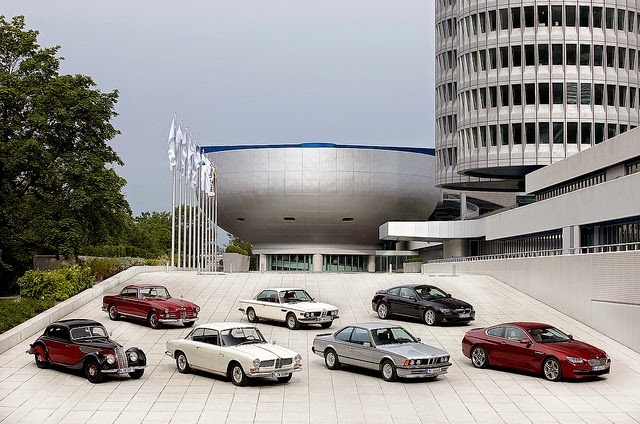
BMW Brand History

Contrary to some opinions, BMW does not stand for Best Motors in the World company. Sure, BMW-branded automobiles are regarded as being some of the few engineering forms close to perfection, but the letters stand for something less boisterous and more good-natured: Bayerische Motoren Werke or Bavarian Motor Works. The secret to their success does not lie in precise astrological predictions or mischievous and blatant employ of corporate espionage, but rather in a dedication to quality and constant pursuit of excellence. Unlike most of the auto manufacturers out there, BMW hasn't focused on a vehicle as a whole but started from its primary source of power, the engine, which has been perfected by generations of engineers over a close-to-a-century time span. The 'cardio-approach' BMW took resulted into obscenely efficient performance-happy engines that literally rocketed the company formed by Karl Friedrich Rapp in October 1913 straight to the sky. Rapp's company, 'Rapp-Motorenwerke' - that would later become BMW - focused mainly on aircraft engines due to the large demand at the time, fueled by the imminence of Wold War I. Despite the need for aircraft engines, Rapp failed to sale his powerplants due to a reliability flaw caused by unwanted engine vibrations. However, his neighbor Gustav Otto, who was also the owner of an aircraft engine plant, enjoyed a great deal of success. Struggles to keep 'Rapp-Motorwerke' afloat failed and, by 1916, Karl Rapp resigned under the weight of the financial difficulties that had been pressing against the factory's lungs for a few years. As in the case of other car brands, such as Bentley or Aston Martin, expected and highly predicable 'Hollywoodian' rescuers came along and fended off the threats. Austrian triumvirate formed by new company owners Franz-Josef Popp and financier Camillo Castiglioni relaunched the Motoren Werke by persuading Gustav Otto into a merger that would prove mutually beneficial. Thus, the 'Bayerische Flugzeug-Werke' or BFW was formed. Shortly after the new entity was born, its name turned into the murmur of what would later become a shout-out for quality automobiles: BMW. By the time the 20's came with the Charleston and its afferent bizarre fashion sense, BMW had already developed a range of highly-appreciated airplane engines that had garnered tons of acclaim - especially after the 1918-improved Type IIIA engine successfully powered a biplane to the impressive height of 16,404 feet in a mere 29 minutes. The beginning of the 20's also happily slapped BMW with its still unchanged to this day logo, mimicking the motion of a white propeller on a sky-blue background. While enjoying the heights of an appreciated and sought for brand, BMW was brutally pulled back to earthy existence once the World War was over. The Treaty of Versailles prohibited BMW from continuing its activity and the company switched to manufacturing air brakes for railway cars. Forced by the Versailles-imposed conditions, the company found itself searching for other alternatives and soon enough came to focus on developing motorcycle engines. Over a two-year period of time (from 1920 to 1922), BMW built two motorcycle models, the Victoria and the Flink. Their success was consequently marked by the building of the first BMW factory, that would further kick the brand to new heights. Although BMW motorcycles encountered sales problems due to defective suspension, the company still managed to hold a constant leading position in aeronautical engineering. By 1927 the company was the proud holder of just over one third of the aviation records of those time, with an astonishing 29 out of an overall 87. Two-wheeled vehicles quickly turned into four-wheeled ones in 1928, when the Austin license-built Dixi 3/15 rolled out the factory doors. Only one year later, BMW made the headlines once again, this time by setting a new motorcycle-speed record through their Ernst Henne ridden 750 cc bike, that reached the speed of 134.65 mph (216.75 km/h). Swinging from breaking world records to engineering innovations, BMW hit the bull's eye once more in 1932, with the launch of their new car model, the 3/20 PS. The 782 cc 4 cylinder powered car was the first one independently produced by BMW. Shortly after the waves of acclaim generated by the new machine, the company announces its next model, the 303 saloon, that would bring a persistent trait in all future BMW engine configurations: the 6 cylinder one. Only years after the launch of the 303 in 1933, BMW continued its world record breaking streak, at the same time with the beginning of a new chapter in its cylinder-powered existence: the development of the company's first roadster, the 328 model (1936), and a row of motor sport wins over the following two years. As time passed by, BMW got bigger and bigger and, shortly before the Wold War II outbreak, took over some more factories in the vicinity of Berlin. More motor sport wins were to follow, with Baron Fritz Huschke von Kanstein winning the Mille Miglia race in 1940s. Needless to mention, war necessities threw the company into military equipment production policies once more. Despite the lengthy world conflict, BMW developed some of its greatest pieces of machinery, such as the R57 Wehrmacht military motorcycle, as well as the 109-300 jet engine which was one of the first jet engines in the world to enter mass production. After recovering from the 1944 bombings that heavily damaged their plant in Munich, BMW received permission to repair Allied army motorized equipment at their plant in Allach. Due to BMW's versatility and need for mechanized faming implements and spare parts, the first BMW bicycle was born. Soon after the genesis of the leg-powered two-wheeled vehicle, BMW received a hard blow from the US army, that had ordered the dismantling of the Munich and Allach plants. After a 5-year absence from the Germany industry, BMW returned in style. Crossing the ocean all the way to New York, BMW debuted their first motorcycle in almost 2 decades - following their last one at the beginning of the 40's. More success awaited in the line for BMW, as their R68 motorcycle model developed in the 50's quickly became a standard-setter among international motorcycle manufacturers. Meanwhile a previous model, the R67/2, reached the 100,000 threshold in 1953. BMW receives further acclaims in the years to come, as it establishes itself as an engineering force to be reckoned with. The 1955 Isetta, powered by a 12/13 hp motorcycle engine, becomes a favorite among customers. The result? Over 160,000 units are sold, transforming the Isetta into a symbol of the post-war decade. Besides coming up with newer models and bending technological improvements on their cars, BMW also held a privileged position among race winners around the world. After the development of the 507 and 600 models, BMW unleashed a shout of childish joy, grabbing an impressive win in the 1958 Austrian GP, through Ernst Hiller. With the help of Herbert Quandt, BMW, still a share-owned company, is brought one step closer to independence. Exterior offers of selling or fusion were turned down despite the enormous profits such a transaction would have led to. The 700 model entered the production lines, together with the R69, BMW's top motorcycle line-up model. The 60's brought a multitude of achievements with the 1500 and 1600 series, as well as a range of new sedans, the 2500, 2800, American Bavaria and the 2.5 CS and 2800 CS coupe models. BMW proved once more that it hasn't left its king-of-the-hill-of-racing spot, as Austrian racing driver Dieter Quester scored several victories in the Formula Two series (as well as a triple European touring car champion title in 1968, 1969 and 1977). However, BMW did not stop there. After having bestowed a great deal of mechanics magic upon the world, the company resumed its entertainment through development and unveiled the 2002 Turbo model in 1973. Following the success of its earlier aircraft engine, the 2002 Turbo is one of the first ever turbos to enter mass-production. Production lines that would become worldwide pieces of success soon came out, such as the 6 and 7 series and the recently reconstructed BMW M1 model. By the end of the 70's, BMW had dug deep into other car-improvement related fields as well, and electronics proved to be the perfect ground for growing BMW's next generation of computerized car devices. Economic fuel research then became top priority. Not only the company was quick in adapting to the fast-moving tendencies of those times, but it also became a steady and reliable supplier of armored cars for different private and public clients.
Racing never lost its fans, consequently BMW never lost enthusiasm in racing. The 80's marked (finally) BMW's involvement in Formula One racing. It was in 1983 that BMW was handed its first title in the series, with Brazilian driver Nelson Piquet becoming king of the Formula One World Racing Championship. At the same time, the 5 series entered a new enhancement stage and was gifted the 518i engine and the powerful M535i. 'M' set a new standard in power and stamina. The M5 and M3 models launched in 1985 and 1986 consequently joined the pinnacle of engineering accuracy and true power and beauty among sports cars enthusiasts. Research started to be heavily reinforced and reached new uncharted areas through the employment of over 6,000 people. Once the Z1 one came along, the profits kept pile-up trend. Caring for the customer and staying ahead of competition was proof enough that BMW had turned into a true, mature brand. Expansion was inevitable and much like a Big Bang, BMW spreads across the world and inaugurated a new car plant in the US, namely in Spartanburg, South Carolina. The models that were in production at the time slowly received touring versions, which helped BMW cover an even larger slice of the market. BMW would later reveal the Z8, a successor of the 507, who later made it to the movies. The world wasn't enough and so were BMW's achievements in their own vision. Since 1999, they have been constantly delivering performance vehicles or 'motorized attire' for their wealthy customers out there. Racing has remained a pleasurable and profitable hobby for the German marque, which emerged victorious in three consecutive FIA WTCC seasons from 2005 to 2007. Only recently, BMW engineers and designers paid homage to the M1 through a modern day replica of the sharp-angled 70's original. Sadly enough, the M1 will not be revived through mass production.Source:autoevolution.com

събота, 26 април 2014 г.

ASTON MARTIN 1914 - 2005 (English)

Aston Martin cars today enjoy an enviable reputation for quality, performance, style and engineering – which puts them at the very pinnacle of the automotive world. For nearly 90 years the company has been shaped by many different owners, all sharing a common passion for power and performance. But the marque’s modern ethos has remained constant since it was instilled at the very beginning of the Aston Martin story. Lionel Martin, an early enthusiast of motor racing. Martin turned his passion into a business in 1913, when he joined forces with Robert Bamford to sell Singer cars – adapting them for the tough up-hill challenges that formed an important part of early motorsport. The partners wanted to manufacture cars of their own – and a name was needed. Martin regularly competed in climbs at Aston Hill – and with the simple combination of a hill and a driver, the Aston Martin legend was born. Bamford and Martin Ltd was incorporated in 1913 to formalise a partnership between Lionel Martin and Robert Bamford. They had been modifying and selling Singer cars from their workshops at 16 Henniker Place, Callow St, Kennsington, London. A decision was made to start and build a whole car of their own design and by 1915, the first Aston-Martin, named Coal Scuttle hit the road; a second car wasn't built until 1920. Thank goodness they build them a little faster now. The car pictured above is one of two Grand Prix Team cars (TT1 and TT2) built for Count Zborowski to compete in the 1922 Isle of Man TT (although they were not ready in time) and subsequently, the French GP in Strasbourg. It is the oldest surviving racing Aston Martin and thankfully is still actively used on the track to this day. Originally featuring a engine with twin camshafts and 16 valves, the car is now fitted with the Benson Twin Cam engine. This was designed by The Hon. John Benson as a new power unit for the cars just before Bamford and Martin called in the receivers in 1925.
The years1910 Founded in 1914 by Lionel Martin and Robert Bamford in a small West London workshop, the company gained the name "Martin" after Bamford’s early retirement, then added with "Aston" as its cars had great success in Aston Clinton Hill Climb race. In 1914 Bamford & Martin Limited bought premises in Chelsea, London – and the following March, the very first Aston Martin car was registered. Fitted with a Coventry Simplex side-valve engine, built to his own specification, it became known as ‘Coal Scuttle’. By 1920 the company was operating from Abingdon Road in Kensington – and motoring pioneer Count Zborowski dug deep into his pockets to fund the construction of two Aston Martin racing cars, which competed in the 1922 French Grand Prix. Now the marque rapidly established its racing credentials. On May 24 that year, an Aston Martin known as ‘Bunny’ broke ten world records at Brooklands, clocking an average speed of 76.04mph during a sixteen and a half hour run. Lionel Martin left the company in 1925, by which time the Charnwood family had a major holding. In 1926 Lord Charnwood joined forces with Augustus Cesare Bertelli and William Somerville Renwick to form Aston Martin Motors at new premises in Victoria Road, Feltham, Middlesex. By 1929 the Aston Martin International model had evolved, establishing new standards for roadholding and handling. In racing guise it helped Bertelli sustain a successful competition programme – and in 1932 he and Pat Driscoll won the Biennial Cup in the Le Mans 24 hours race.?Towards the end of that year the Company passed into the hands of Sir Arthur Sutherland and was managed by his son, Gordon. The International was succeeded by the Le Mans model, which in turn gave way to the Ulster. Then in 1936, it was decided to focus on a touring car, with the appearance of the 2.0 litre engine for the 15/98. Early in 1939, a prototype was built using independent front suspension and a Cotal electric gearbox, packaged in an early form of space frame. Known as the Atom, it ran throughout World War Two and although it never went into production, it formed the basis of the first generation of post-war Aston Martins. The next significant chapter in the Aston Martin story came in 1947, when David Brown bought the Feltham company – and the DB era dawned. Brown had a passion for high performance cars and wanted his new marque to win worldwide recognition. That year he also bought the Lagonda Company, a natural stablemate. Though thoroughly British, the name reflected founder Wilbur Gunn's early life at Lagonda, Ohio.?Lagonda had started life in 1898, when Gunn produced a small engine to power his bicycle. Motor cycles followed and in 1904, tricars appeared. Like Aston Martin, it had rapidly established a name in early motorsport. In 1921, a single-seater competition car set five records and covered 79.17 miles in one hour. The records were all lost to Aston Martin one week later. A Lagonda won the 1935 Le Mans 24 hours race and in 1938 a V12 saloon covered 101.5 miles in one hour, including a stop to change a tyre. The combined resources of Aston Martin and Lagonda under David Brown bought new dynamism – and great achievement on and off the track. In 1948 the 2.0 Litre Sports entered production and won that year's 24 hours sports car race at Spa. The years1950 Despite of frequent change of owners, the tiny maker was unknown until the DB2 came in 1950. It started the DB series, all powered by a straight six engine. From 2.6 litres to 3.6 litres in DB4, then 4.0 litres in DB5 which was starred in James Bond’s movie "Gold Finger". The DB series got a reputation as the finest British sports car because of its balance between performance and luxury (Lotus was too raw), also because of its good craftsmanship and tasteful styling.
During the 50’s and 60’s, Aston was quite active in motor racing. Its DBR1/300 won the World Sports Car Championship in 1959. DB2 won a class victory in Le Mans. The DB4GT Zagato also fought fiercely with Ferrari 250GTO. However, the lack of fund and development prevent Aston from more success. In April 1950 the 2.6 litre DB2 was announced. It took equal first in the Index of Performance at that year’s Le Mans – and won the 3.0 litre class. Both Aston Martin and Lagonda cars were now built at Hanworth Park in Feltham, with engines, chassis and running gear assembled at David Brown’s factory at Farsley in Yorkshire.?Then in 1954, Brown bought Tickford Motor Bodies in Newport Pagnell – where the offices and production facilities for the V12 Vanquish are now located. Established in 1820, the site had originally been occupied by Salmons & Sons, ‘Coachbuilders to the Nobility’, but by 1957 it was truly home to Aston Martin and Lagonda. Most components – including engines – were manufactured and assembled there. That year saw the DB Mk III, one of the first production cars to feature disc brakes – a direct development of the company's racing experience. The company’s racing programme reached a peak with the phenomenal success of the DBR1/300, which won the World Sports Car Championship in 1959. During the late 1950s, four Works DBR1s won six World Championship races and set five lap records. The DB4, which represented a major leap forward in design, was introduced in 1958. Styled by Touring of Milan, it was equipped with a 3.7 litre aluminium alloy engine designed by Aston Martin.?The rapidly rising cost of racing began to take its toll and by the end of 1963 it was decided to withdraw from motorsport and concentrate on refining the production cars. The years1960 Through out the years, Aston Martin collected more name plates, such as luxurious car maker Lagonda and coachbuilder Tickford. It was a bold but enlightened decision – and heralded a new era for Aston Martin as the company’s production and reputation stepped up a gear. In October 1963, the legendary 4 litre DB5 was introduced. Production was doubled to meet world demand. The car owed some of its global esteem to a starring role in the James Bond films ‘Goldfinger’ and ‘Thunderball’ – where its ‘factory fitted options’ included machine guns, a passenger ejector seat, hydraulic over-rider rams and equipment for projecting oil, nails and smoke. The DB6 appeared in 1965 and remained in production until 1970. Its convertible equivalent, the Volante, was the first European car with a power-operated hood.
When the V8-engined DBS launched in 1969, the Aston Martin was still one of the most important sports car specialists in the world. People still compare its cars with Ferrari and Maserati. Through the 70’s, more change of ownership resulted in lack of research and development. AM became relying on the old tradition of styling, craftsmanship and luxury to keep the old customers delighted. It was regarded as another Bentley, just faster and rarer. Technology lagged behind the competition. It was followed by the DBS in 1967, the biggest advance in Grand Touring styling and design since the DB4. Completely designed at Newport Pagnell, it came with a 4.0 litre engine and later evolved into the DBSV8. In 1972 Aston Martin Lagonda entered another new era – in which ownership was to change several times.?First it was acquired by Company Developments, a Birmingham-based group of businessmen, with Sir David Brown retaining a seat on the board and becoming President. Production of the DBS and DBSV8 continued until May 1972 when modified versions appeared under the new name of Aston Martin Vantage and AM V8. The company again changed hands again in 1975, when it was taken over by North American Peter Sprague and Canadian George Minden. There were immediate moves to inject new vitality and a direct result was the appearance of a totally new Lagonda in 1976. With coachwork by William Towns, who had previously styled the DBS, its strikingly modern appearance and very advanced specification made a considerable impact. The following year saw the introduction of the Aston Martin V8 Vantage and a year later a convertible version, the Volante, was unveiled. A revolutionary mid-engined two-seater called Bulldog appeared in 1980. With ultra-high performance, and styled by William Towns, it had gull wings 5.3 V8 fuel injection engine with twin turbochargers. In 1981 Aston Martin Lagonda was again taken over, this time by petrol company Pace Petroleum and CH Industrials. Two years later Automotive Investments took control and in 1984 the company changed hands when the family of Peter Livanos took 75 per cent, and Victor Gauntlett 25 per cent. The years1980
A 186mph supercar called "Zagato" was built by coach-builder Zagato in 1986 based on the Vantage, but that didn’t cure the deep rooted problem in Aston. Aston Martin Lagonda partnered the Italian style house to create the 180mph Vantage Zagato – an exclusive model of which just 50 were built. The following year the company again teamed up with James Bond in ‘The Living Daylights’ – and Ford purchased 75 per cent of the company's shares. In October 1988, the Virage was unveiled. Designed to take the Company into the 21st century, this 150mph, two-door 2+2 replaced the V8, which had been in production for 20 years. When the Virage went into production in 1990, the build quality was also in doubt, thanks to the use of Ford’s parts such as rear lights. Ford bought 75% shares in 1987 and funded the development of a new car, DB7. Because Aston no longer had the R&D experts as it was in the 50’s and 60’s, the new car development was handed to Tom Walkinshaw’s TWR. Production also took place in the modern factory of TWR. With Ford’s involvement there was investment in design, production and the sourcing of components and materials. 1992 saw an extension of the Virage model range – with a 6.3 litre engine conversion, and the debut of the first production model of the Virage Volante Convertible. The 550 horsepowered twin supercharged Vantage was also previewed. At the 1993 Geneva Show, Aston Martin announced the return of a DB model for the first time in more than 20 years. The Aston Martin DB7 was named ‘ Car of the Show’. That summer Ford took complete ownership of Aston Martin Lagonda, having invested £65 million in the company for the design, development and provision of manufacturing facilities for the DB7. To accommodate the DB7, the company bought a specialist paint and assembly plant at Bloxham in Oxfordshire from JaguarSport. A record was established in 1995 when more than 700 new cars were produced and delivered in a single year for the first time in the company’s history. In addition to the spectacular success of the DB7, production of the Vantage passed the 100 mark and preparations were made for the introduction of the DB7 Volante model to the United States. The world debut of the DB7 Volante at the Detroit and Los Angeles International Auto Shows in 1996 signalled the return of Aston Martin to North America.?Meanwhile the DB7 rapidly developed into the most successful car ever built by Aston Martin Lagonda. The 1,000th DB7 was completed in October 1996 and the 2,000th car in July 1998. The years1990
Major introductions in 1999 included the launch of the first ever 12 cylinder Aston Martin DB7 Vantage and Vantage Volante, powered by a 6.0 litre 420 horsepower Aston Martin V12 engines designed and developed in close cooperation with Ford RVT and Cosworth. In July 2000 Dr Ulrich Bez joined the company as Chief Executive – and October saw the end of an era with the last delivery of an Aston Martin V8 engined model. Since the DBS began production in 1970, Aston Martin constructed 5,016 V8 models at Newport Pagnell – and 30 years of continuous refinement and improvement saw the engine’s output double from 300 to 600 horsepower. In February 2001 the V12 Vanquish, the most sophisticated and technologically advanced new model ever to be designed, developed and built by Aston Martin, was unveiled at the Geneva Motor Show. This totally new Aston Martin built at Newport Pagnell, and became Aston Martin's new flagship model. In September 2002 the DB7 maintained its position as the most successful and popular Aston Martin model of all-time when the 6,000th model - a Vantage Coupe – was completed. Total DB7 production now exceeds the combined total of the world famous DB4, DB5 and DB6 models. In nearly 90 years the marque has seen many changes. But with subtle understatement it has retained the reputation that is now so cherished by a growing army of the world over: “ A quality car of good performance and appearance: a car for the discerning owner driver with fast touring in mind, designed, developed, engineered and built as an individual.“ The years 2000 The Aston Martin DB 9 produced since 2004 featuring a 5.9 liters / 450 hp engine. Източник:speedace.info

вторник, 22 април 2014 г.

The History of Mercedes-Benz brand

The Mercedes-Benz brand was born under a lucky star: the current trademark comprising a three-pointed star in a laurel wreath was created in 1925 – in time for the merger between Daimler-Motoren-Gesellschaft (DMG) and Benz & Cie., which together became Daimler-Benz AG, in summer 1926. His event marked the birth of a new car brand – Mercedes-Benz – and with it a shared aspiration to uphold the tradition of the world's two oldest car manufacturers and ensure a successful future for both. Innovation, performance, quality, awareness of tradition: the Mercedes-Benz trademark, one of the world's most familiar and esteemed brand symbols, has stood for these and other values ever since. Source:daimler.com